My name is Scott G. I’m a 38-year-old software engineer with a background in recreational weightlifting and occasional 5k runs. I decided to take on the Hyrox challenge in Auckland, Australia at the beginning of February 2025. I’d been lifting weights regularly and considered myself reasonably fit, but had never attempted anything quite like Hyrox, which I knew involved a combination of running and functional fitness exercises. I figured that my general fitness would be enough, and that I could pick up the techniques as I went along.
The event was held in a large convention center, which I was impressed by, remarking to myself how it had the feeling of a “cathedral of fitness”. I checked in smoothly, grabbed some free samples, and headed to the warm-up area to familiarize myself with some of the equipment. I chatted briefly with a volunteer, but didn’t think to ask about specifics such as laps or distances. I felt a surge of nervous energy as I was directed into a corral with about 30 other athletes. A countdown clock started, and the race began.
The Race Begins

I started the race with a surge of adrenaline, the first 1k run feeling surprisingly quick. I tried to track my pace on my smartwatch, but the numbers seemed off, so I abandoned it and decided to go by feel. After the first run, I arrived at the SkiErg station. As a fan of CrossFit, the SkiErg felt familiar and I was initially pleased with my pace, completing the section quickly. This gave me a false sense of confidence and I made a mistake that many first-time Hyrox athletes make. I tried to keep up with another athlete who I found myself running alongside, pushing myself too hard, too early. My heart rate soared to 170 bpm, a pace I struggled to recover from for the rest of the race. This taught me a valuable lesson: run your own race, at your own pace.
Next came the sled push, and even though I had never done one before, I enjoyed the primal feeling of pushing the weight. The sled push was physically taxing, but it was my calf muscles, not my quads that were feeling it during the run that followed.
Things Start to Go Wrong

During the second run, I felt the distance more keenly. I sought clarification from a fellow competitor on the number of laps per run, but the advice was inaccurate, and I only completed two laps, missing out on some distance. I learned later that I should have been doing about 2.8 laps each time, and this cost me time later in penalties. This was lesson two: read the race day guide for your specific venue and event, and read it twice.
I then came to the sled pull. This was another exercise I had never attempted, but I tried to figure it out on the fly. I started by pulling with my arms, but soon realized my biceps were tiring. I shifted to a backwards shuffle to give my arms a break, and while it was slower, I got it done. By the time I finished, I was aware that I’d made a mistake with the laps on the track, and I was beginning to feel frustrated.
This frustration increased when I went to the burpee broad jump station, and confirmed with a judge that I had entered the Roxzone too early, which forced me to do an additional lap.
No Man’s Land
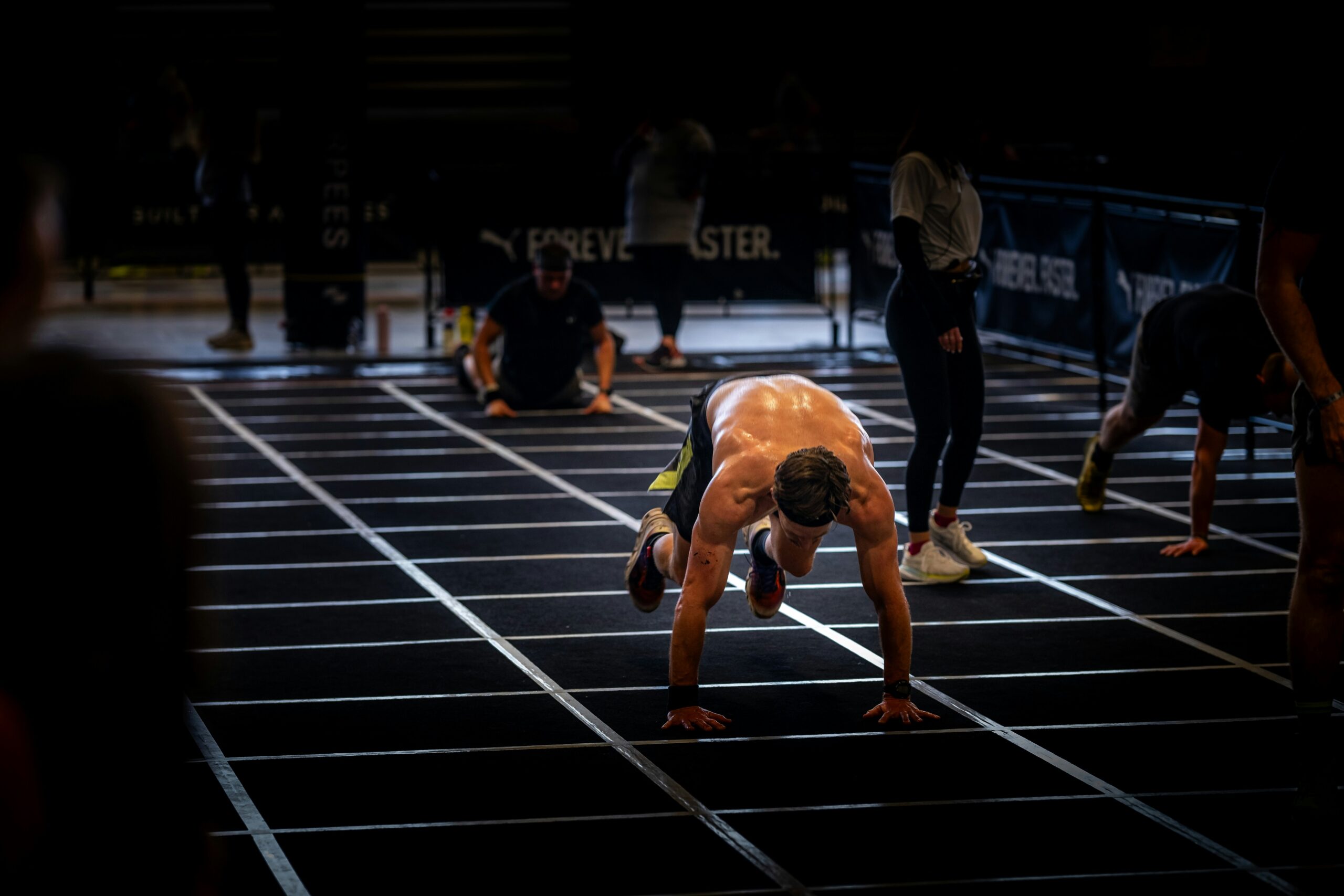
The burpees were an exercise that I had not expected to be so difficult, and my mistake with the laps was taking a toll on my mindset. I was also halfway through the race, and now facing a time penalty, which made my body feel heavy. This was the point when the “never again” thoughts crept in.
Finding My Rhythm
Despite my earlier negativity, a shift occurred as I started the fifth run. I allowed myself to look around and took in the atmosphere. The variety of people participating buoyed my spirits. I began to find the fun in the challenge and realized: it’s meant to be fun, so whatever happens, just enjoy yourself. I settled into a meditative state, and the runs became more consistent.
I found the rowing machine to be a welcome change. I was able to catch my breath and make up some ground with slow and powerful strokes. The farmer’s carry also went smoothly, thanks to some humorous support from my girlfriend. My CrossFit background proved helpful with the sandbag lunges.
However, by the seventh station, I was feeling the effects of inadequate fuel. I realized my small pre-race porridge had been insufficient for the length and intensity of the event. I relied on the electrolytes provided at each station to get by. Lesson five: Prepare well and fuel properly.
The Home Stretch
I realized that due to earlier mistakes, I still needed to do an additional lap. The wall balls, the last station, lived up to their terrible reputation. My quads, glutes, and shoulders were screaming at me. I kept going, doing sets of 25, 15 and 10, before finishing the last 20 and stumbling across the finish line to collapse and find a banana.
I finished with a time of 1 hour and 28 minutes, including penalties. I finally ditched my sweat-soaked shirt and felt the relief of the finishing line. The last lesson, lesson six, is to dress appropriately and look after your body during the event – nipples and all.
Verdict
Despite the pain and mistakes, crossing the finish line was an amazing feeling. I received a velcro patch for finishing in 1h 53min, and launched into a detailed debrief, which my partner endured patiently.
Despite some “never again” feelings, I admitted that I had actually begun to enjoy the race in the last few stations. I was disappointed by my time but had something to improve upon. Immediately, I went online to search for the next Hyrox race.
My first Hyrox race was far from perfect, but it was a learning experience. I went from feeling frustrated and disheartened to finding a rhythm and enjoying the challenge. I now had a better understanding of what it takes to complete a Hyrox race, and I will be better prepared for the next one.