When preparing for race day, investing in a concept2 skierg hyrox training setup is the single most effective hardware upgrade you can make for your home gym. Station 1 is a 1,000-metre test that arrives after your very first 1 km run, setting the physiological tone for the entire event. If you misjudge your split time or burn out your lats in the opening three minutes, your subsequent sled push and sled pull splits will pay the price.
This post contains affiliate links. If you buy through them we may earn a commission at no extra cost to you. As an Amazon Associate we earn from qualifying purchases.
Owning a dedicated ski trainer allows you to dial in your stroke rate, damper settings, and compromised pacing from home. However, prospective buyers inevitably face a pivotal hardware dilemma: should you bolt the unit directly into your wall studs, or buy the optional steel floor stand?
In this guide, we break down the engineering specs, footprint trade-offs, stability factors, and honest limitations of both mounting options, alongside budget alternatives, so you can pick the exact configuration that fits your training space.
1. Station 1 Reality: Why 1,000m on the SkiErg Dictates Your Entire Race
The 1,000-metre SkiErg is Station 1 in every official HYROX race format. Under official HYROX rulebook standards, athletes must complete the full distance before exiting the station box to start their second 1 km running lap.
Many first-time racers make the critical mistake of treating Station 1 as a standalone sprint. Pulling at a 1:38/500m split might look impressive on the leaderboard for four minutes, but the resulting lactate accumulation directly undermines your quad drive on the 152 kg (335 lb) or 202 kg (445 lb) sled push that follows immediately in Station 2.
Mastering this station requires consistency, cadence control, and regular threshold training. You can explore pacing strategies in our guide on how to Crush the HYROX SkiErg. Training on the authentic machine ensures that the drag factor and power curve you see in training match race day down to the tenth of a second.
2. Concept2 SkiErg HYROX Specs: Wall Mount vs Floor Stand
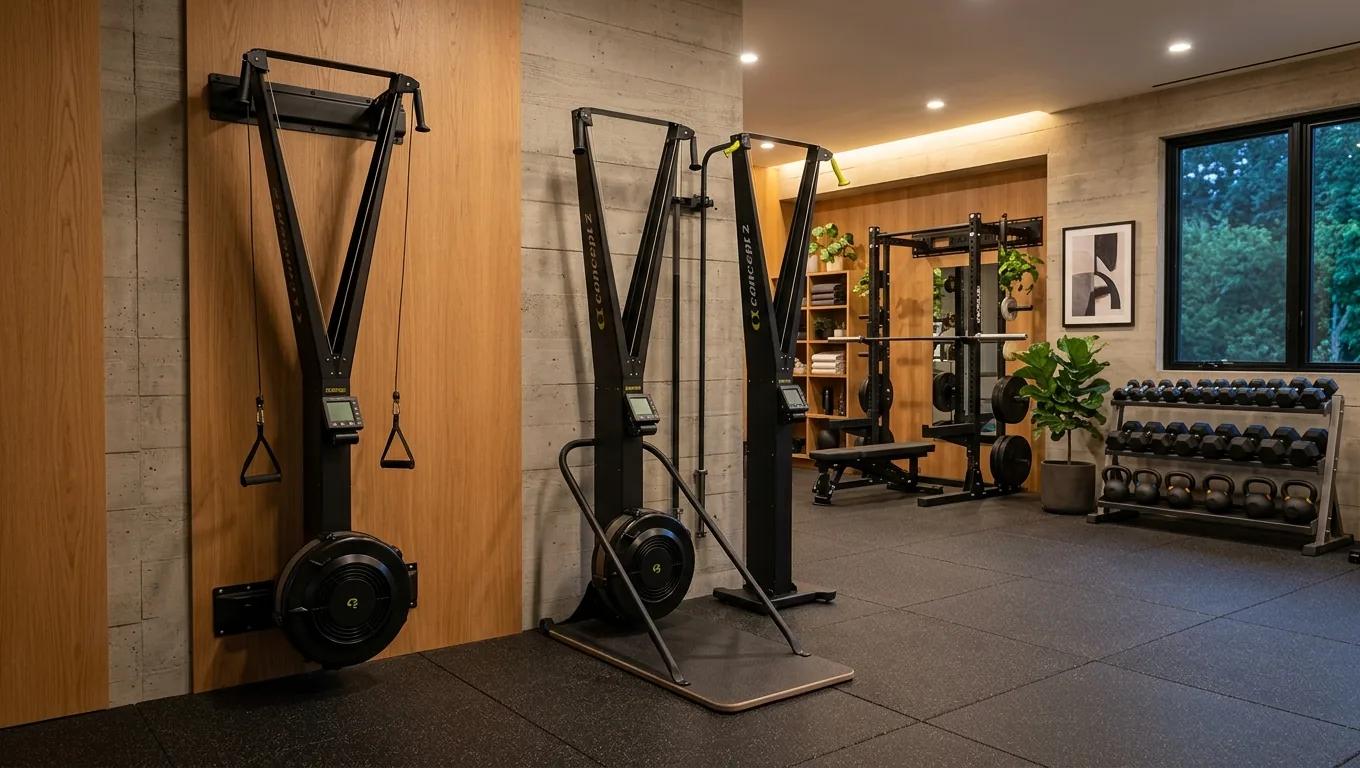
Both setups share the identical Concept2 flywheel, PM5 monitor, drive cords, and ergonomic strapless handles. The distinction lies entirely in their mounting architecture, stability, and spatial footprint.
According to official Concept2 product specifications, here is how the physical dimensions and structural requirements compare side by side:
| Specification | Concept2 SkiErg (Wall Mount) | Concept2 SkiErg (Floor Stand) | GMWD Ski Machine (Budget) |
|---|---|---|---|
| Mounting Style | Wall bolted (studs/masonry) | Freestanding floor base | Freestanding frame |
| Width (Base / Frame) | 48.3 cm (19 in) at bottom | 60 cm (23.5 in) base width | 58 cm (22.8 in) |
| Depth / Length | 40.6 cm (16 in) depth | 127 cm (50 in) platform length | 120 cm (47.2 in) |
| Height | 216 cm (85 in) | 216 cm (85 in) | 214 cm (84.3 in) |
| Total Weight | 20.9 kg (46 lb) | 38 kg (84 lb) total | 32 kg (70.5 lb) |
| Portability | Fixed (zero mobility) | Caster wheels built-in | Basic rear wheels |
| Monitor / Data | Concept2 PM5 (calibrated) | Concept2 PM5 (calibrated) | Basic LCD (uncalibrated) |
| Best For | Tight spaces & permanent gyms | Renters & flexible layouts | Movement practice on a budget |
3. Concept2 SkiErg Wall Mount: The Zero-Footprint Powerhouse
The wall-mounted Concept2 SkiErg is the default configuration supplied by the manufacturer. It attaches to a vertical wall using two mounting brackets spaced for standard 40.6 cm (16 in) wooden wall studs, or directly into solid concrete and brick with masonry anchors.
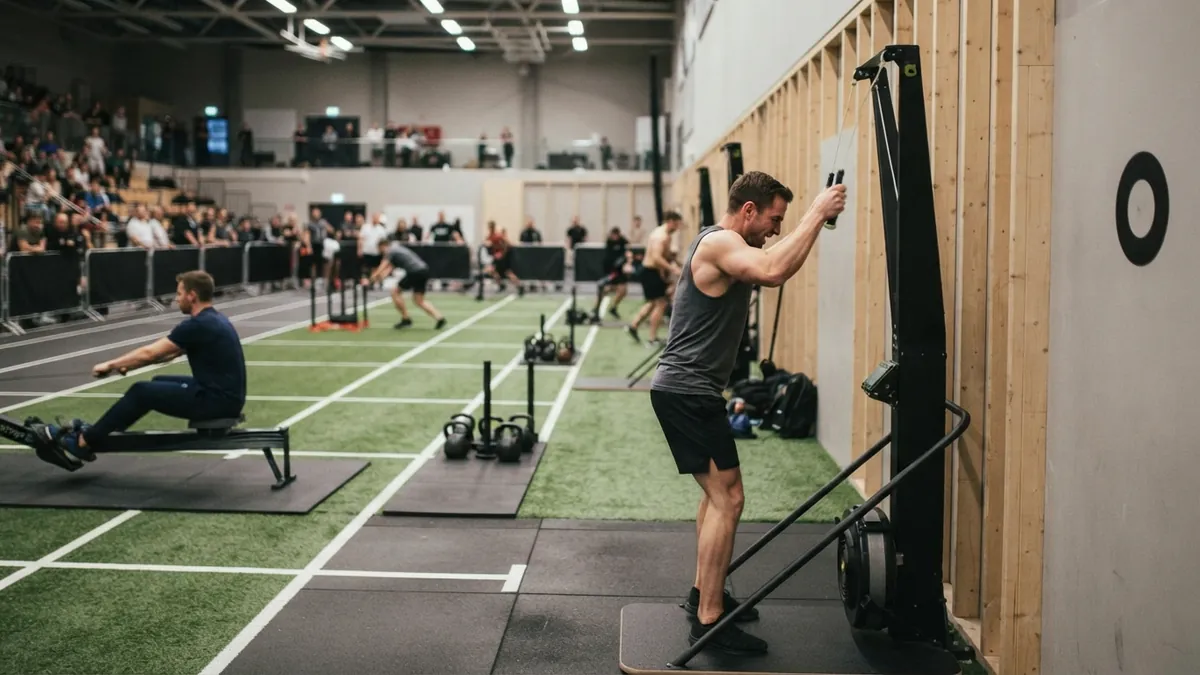
The Big Advantages
- Negligible Floor Footprint: With a depth profile of only 40.6 cm (16 in), the wall mount takes virtually zero usable square footage off your gym floor. When you finish pulling, the handles hang cleanly against the wall, leaving the floor open for kettlebell work, lunges, or treadmill access.
- Rock-Solid Stability: Because the top and bottom brackets anchor into load-bearing wall studs, there is zero frame flex. Even during high-wattage interval sprints below 1:35/500m, the unit will not budge or creak.
- Lower Upfront Cost: You do not have to purchase the optional floor stand accessory, saving money that you can direct toward other race essentials. Check out our recommendations in An effective guide to train for Hyrox at Home.
Honest Drawbacks
- Permanent Installation: You must drill heavy lag screws into your wall. If you rent an apartment or move frequently, wall-mounting may violate your lease agreement or leave noticeable wall repairs upon moving out.
- Zero Mobility: Once secured, the machine cannot be shifted outdoors for summer workouts or repositioned when rearranging your equipment layout.
- Ceiling Height Dependency: Your wall must accommodate the full 216 cm (85 in) height without obstruction from low joists, garage door tracks, or overhead ductwork.
4. Concept2 SkiErg with Floor Stand: Maximum Portability for Renters
If drilling into your walls is out of the question, the Concept2 floor stand transforms the SkiErg into a completely freestanding, mobile training station.
The stand features a heavy-duty steel support frame paired with a wooden, wear-resistant base platform treated with an anti-skid textured top surface.
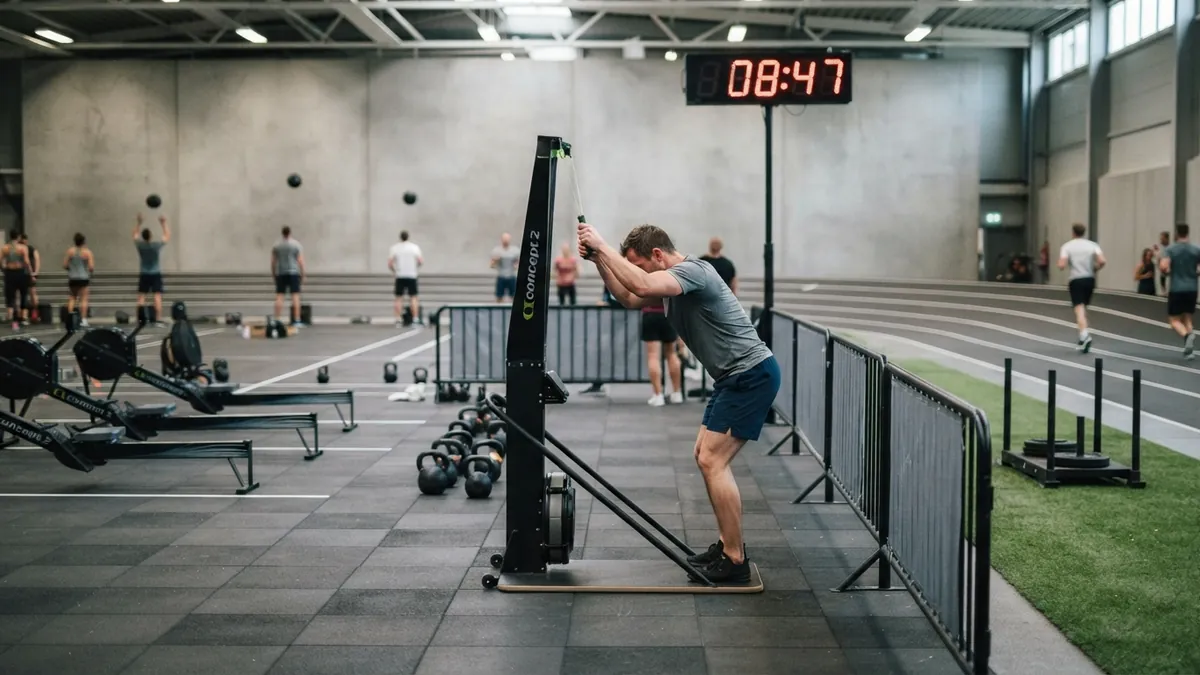
The Big Advantages
- Zero Wall Damage: No drilling, stud finders, or drywall patching required. You assemble the stand, bolt the SkiErg to the steel uprights, and you are ready to train immediately.
- Effortless Portability: Built-in urethane caster wheels on the front edge allow you to tilt the entire 38 kg (84 lb) apparatus backward and roll it across your gym floor, garage, or outdoor patio.
- Self-Contained Footing: The wide wooden base platform gives you a consistent, grippy stance regardless of whether your gym floor is slick epoxy, polished hardwood, or dusty concrete.
Honest Drawbacks
- Substantial Floor Space: The platform extends 127 cm (50 in) into the room. In compact garage gyms or spare bedrooms, a 1.27-metre footprint is a significant commitment.
- Platform Vibration Under Maximum Load: While exceptionally sturdy for normal pacing, violent pulling at maximum power can produce subtle flex or floor resonance if your subfloor is uneven.
- Added Cost: The floor stand is sold as an add-on accessory, increasing the overall cost of your training package. Review complete equipment considerations in our overview of HYROX: Gear Up For Success!.
5. Budget Alternative: GMWD Ski Machine (Movement Pattern vs Race Simulation)
For athletes seeking to build pulling endurance on a tighter budget, third-party wind-resistance trainers like the GMWD Ski Exercise Machine represent an entry-level alternative.
Where It Works
The GMWD unit provides a freestanding dual-cord resistance mechanism that effectively targets the latissimus dorsi, core, and posterior chain. It allows you to practice the triple-extension hinge mechanics required for efficient double-poling technique without paying premium prices.
The Crucial Limitation
The critical drawback is measurement fidelity. Official HYROX events rely on the precisely calibrated flywheel physics and electronic drag factor calculation of the Concept2 PM5 monitor.
Budget trainers utilize uncalibrated impellers and basic LCD consoles. A 2:00/500m pace displayed on a budget screen does not correlate with a 2:00/500m pace on an official race rig. If you use an alternative machine, treat it strictly as a conditioning tool rather than an exact pace benchmark. Read more options in our breakdown of Smart Ski ERG Alternatives.
6. The Verdict: Which Setup Belongs in Your Hyrox Training Space?
Choosing the right concept2 skierg hyrox configuration comes down to your housing arrangement, floor layout, and budget.
- Choose the Wall Mount if: You own your home, have sturdy wall studs with 216 cm (85 in) of vertical clearance, and want maximum structural rigidity while keeping your gym floor 100% open.
- Choose the Floor Stand if: You rent, lack accessible wall studs, need to roll your equipment out of the way after workouts, or want the versatility to train outdoors.
- Choose a Budget Alternative if: You solely need upper-body conditioning volume and do not require exact split calibration for race day planning.
Understanding your gear needs and equipment standards helps you allocate your budget smartly. Make sure to consult The Definitive Guide to Official Hyrox Weights to ensure all your home gear matches race regulations.
Conclusion: Building Your Station 1 Advantage
Station 1 sets the cadence for your entire race. Having reliable access to a concept2 skierg hyrox trainer turns a potentially punishing opening station into a controlled, tactical strength.
Whether you mount your unit to the wall for a sleek footprint or roll it out on the floor stand for maximum versatility, the real return comes from building consistent, repeatable pulling power before you step into the start corral.
Frequently asked questions
Is the Concept2 SkiErg the exact machine used at official HYROX races?
Yes. Every official HYROX event worldwide uses the Concept2 SkiErg equipped with a PM5 performance monitor at Station 1 for the 1,000-metre distance.
What damper setting should I use on the SkiErg for HYROX?
Most competitors race at a damper setting between 5 and 6. This strikes the optimal balance between flywheel resistance and turnover rate, preserving shoulder and lat fatigue for the sleds.
Can one person assemble the Concept2 floor stand alone?
Yes. The stand can be assembled in roughly 30 to 45 minutes with the included tools, though having a second person makes lifting the main flywheel unit onto the base significantly easier.
How much ceiling height do I need for a Concept2 SkiErg?
The machine itself is 216 cm (85 in) tall. You should have at least 225 cm to 230 cm (approx. 7 ft 6 in) of vertical clearance to pull comfortably with full arm extension.