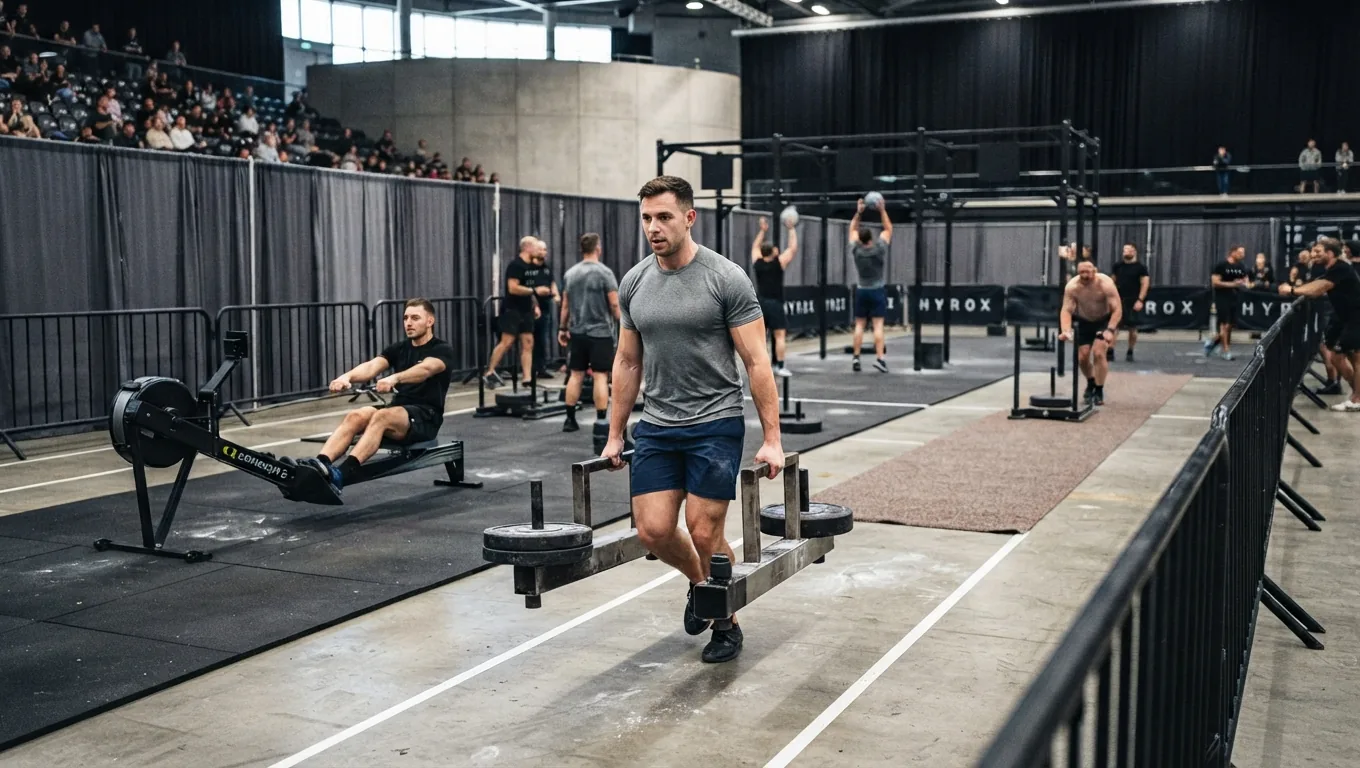
You step into Station 6 after five kilometres of running, two heavy sled efforts, eighty burpee broad jumps, and one thousand metres on the rowing machine. Your forearms are humming from holding the rower handle, and your core is fatigued from resisting rotational load.
The hyrox farmer carry looks simple on paper: pick up two heavy kettlebells, walk 200 metres, and put them back down. Yet every race weekend, dozens of athletes reach the 120-metre mark only to experience sudden, catastrophic grip failure. Their fingers uncurl, the bells crash to the turf, and what should be a two-minute station turns into a four-minute ordeal.
Here is why your grip gives out, the official rules that dictate your strategy, and how to execute this station with maximum efficiency.
1. The Costly Mistake: Sprinting the First 50 Metres
The single most common error on the farmer carry is treating the start like a sprint. Athletes exit the Roxzone with high adrenaline, grab the handles, and take long, rapid strides down the first lane.
This creates a hidden mechanical penalty: the pendulum swing. When you take long, aggressive strides while carrying heavy kettlebells, the weights oscillate forward and backward alongside your hips.
Each time a 24 kg (53 lb) or 32 kg (70 lb) kettlebell swings to the end of its arc, momentum multiplies the peak gravitational load on your fingers by up to 1.8 times the static weight. Your forearm flexors are forced into rapid eccentric contractions to keep the handle inside your palms.
By metre 75, that dynamic swinging drains your forearm energy stores. By metre 120, your grip is shot.
The fix is a controlled, high-cadence walk:
- Shorten your stride: Take quick, rhythmic steps roughly 70% of your normal walking length.
- Pin your lats: Pull your shoulder blades down and back to keep the kettlebells glued to the sides of your thighs.
- Mental cue: “Quiet bells, fast feet.” If the kettlebells slap your hips, your stride is too long.
2. The Official Rulebook: Weights, Boxes, and Hyrox Farmer Carry Standards
Before stepping onto the race floor, you must know the exact standards enforced by technical judges. The official HYROX race format and Singles Rulebook outline strict requirements for weights, boundaries, and equipment handling.
| Division | Kettlebell Weight (Each Hand) | Total Carried Load | Handle Colour Markings |
|---|---|---|---|
| Women Open | 16 kg (35 lb) | 32 kg (70 lb) | White |
| Men Open | 24 kg (53 lb) | 48 kg (106 lb) | Grey |
| Women Pro | 24 kg (53 lb) | 48 kg (106 lb) | Grey |
| Men Pro | 32 kg (70 lb) | 64 kg (140 lb) | Black |
| Mixed Doubles | 24 kg (53 lb) | 48 kg (106 lb) | Grey |
To see how these loads compare across the entire course, consult the definitive guide to official Hyrox weights.
Key rulebook details every competitor must remember:
- Resting is legal: You are fully permitted to set the kettlebells down on the ground to rest as often as you need. However, the weights must remain completely stationary. Dragging or rolling them forward while grounded is an infringement.
- Chalk is permitted: Chalk is strictly banned across most of the arena, but the rulebook explicitly allows magnesium chalk at only two stations: the Sled Pull and the Farmer Carry.
- The box finish standard: When finishing your 200m carry, both kettlebells must be returned to the marked starting box standing upright. If you toss the bells and they bounce outside the box or topple over, you face a 30-second penalty unless you return and set them upright before leaving the station.
- Overtaking is allowed: Modern race layouts permit overtaking slower competitors provided you leave sufficient space.
3. The Turnaround Tax: Where 10 to 15 Seconds Silently Bleed
The 200m distance is typically laid out as four 50-metre lengths (or two 100-metre out-and-back segments depending on arena dimensions). That means navigating three to seven distinct turnarounds around marked cones.
Most athletes bleed substantial time and grip strength in the turns:
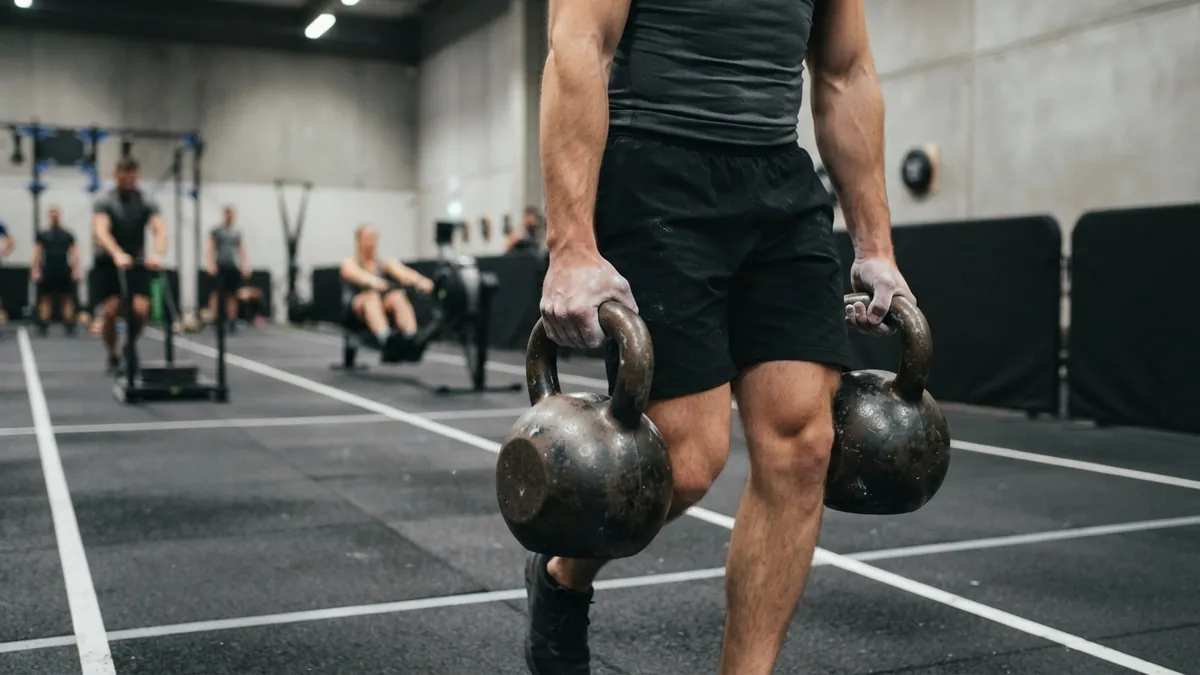
When you take a wide, looping turn:
- You add five to eight metres of unnecessary distance across the station.
- Centrifugal force pulls the outside kettlebell away from your body, twisting your spine and spiking grip fatigue.
The Tight Pivot Technique:
- Anticipate the turn: One stride before the marker, decelerate forward momentum.
- Step inside the cone: Plant your inside foot close to the marker and pivot your hips sharply around the axis.
- Keep the weights close: Do not let the kettlebells swing outward; brace your obliques and accelerate out of the turn in a straight line.
Mastering this tight pivot saves 2 to 3 seconds per turn, adding up to over 10 seconds of free time without extra cardiovascular cost.
4. Grip Anatomy: Forearm Flexors vs Systemic Core Fatigue
Why does your grip suddenly fail on Station 6 even if you deadlift heavy in the gym?
Carrying heavy loads over distance relies on sustained isometric finger flexion powered by the flexor digitorum superficialis and flexor digitorum profundus. In a standard gym lift, you hold the bar for a few seconds. In the hyrox farmer carry, you demand unbroken isometric tension for 90 to 150 seconds. As detailed in strength research on loaded carry biomechanics, carrying heavy loads taxes both local forearm endurance and systemic postural stiffness simultaneously.
Compounding this is the systemic fatigue built over the preceding 40 minutes of racing. When your postural stabilizers tire, your upper back rounds forward. This internal shoulder rotation shifts the center of mass forward, forcing your fingertips to take the brunt of the load.
Understanding this systemic fatigue is key to managing the race, especially when dealing with why your legs turn to jelly in Hyrox as you transition between heavy stations.
Grip Setup Tactics:
- Centre the handle: Grip the kettlebell handle dead centre. Grabbing too far forward tilts the bell backward, peeling your index finger off the metal.
- The Hook Grip Alternative: If you have large hands, wrapping your index and middle fingers over your thumb locks the handle in place and reduces active forearm strain.
5. The Training Drills: Building Unbroken 200m Stamina
To conquer this station, your training must go beyond standard gym walks. You need specific drills that build grip endurance under pre-exhaustion.
Integrating targeted grip work into your essential Hyrox strength training routine creates resilient tendons and a bulletproof core.
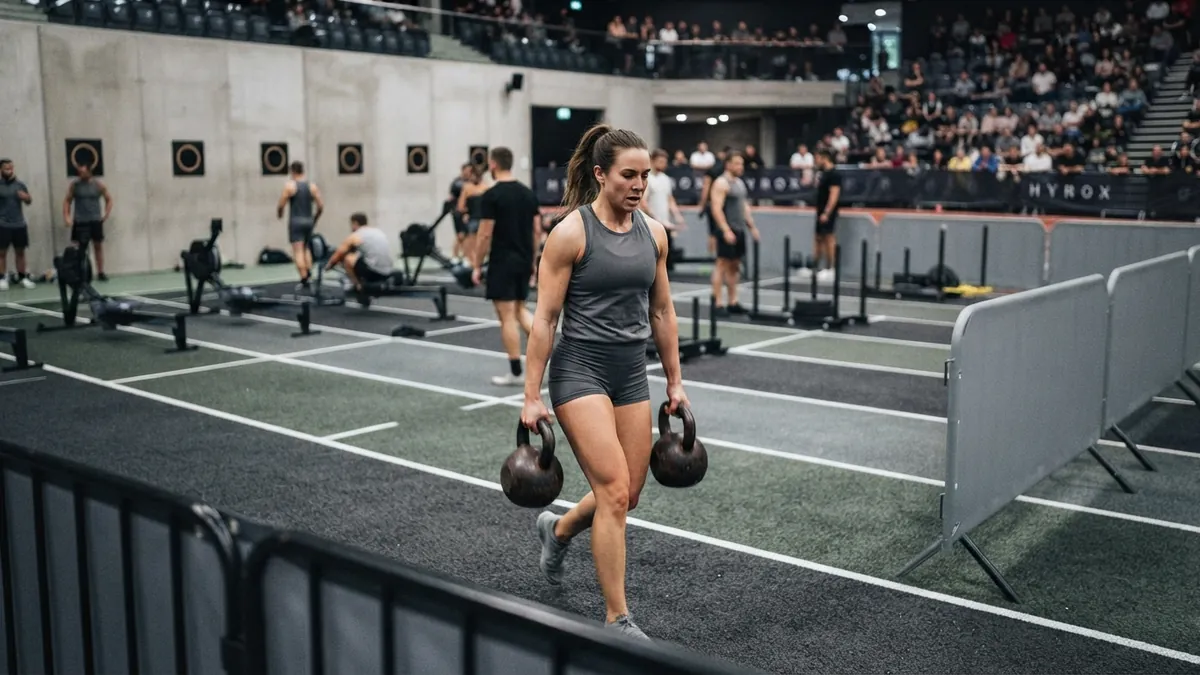
Here are three highly effective training drills:
Drill 1: The Overload Suitcase Carry
- How: Hold a single kettlebell that is 20% heavier than race weight (e.g., 28–32 kg for Men Open) in one hand. Walk 50 metres, switch hands, and return.
- Why: The offset load forces your contralateral obliques to fire intensely, preventing torso sway.
- Dose: 4 sets of 50m per side, resting 60 seconds between sets.
Drill 2: Compromised Row-to-Carry Complexes
- How: Complete a 500m row at race pace, unstrap immediately, and pick up competition-weight kettlebells for a 100m carry.
- Why: Replicates the exact neuromuscular transition from Station 5 (Rowing) to Station 6 (Farmer Carry).
- Dose: 3 rounds with 90 seconds rest.
Drill 3: Dead Hangs and Fat-Grip Timed Holds
- How: Perform active pull-up bar dead hangs, or hold a loaded barbell with fat-grip adaptors for 45 to 60 seconds.
- Why: Builds dense isometric capacity in the deep finger flexors.
- Dose: 3 sets to failure at the end of training sessions.
6. Race Day Execution: The Pacing and Drop Strategy
On race morning, strategy determines whether you leave Station 6 energized or completely depleted.
Before entering the station, use your Roxzone jog to wipe sweat from your palms onto your shorts. If your hands are slick, take 5 seconds at the chalk basin to dust your fingers.
The Strategic Decision: Unbroken vs Planned Micro-Drop
Every athlete dreams of going unbroken, but an unplanned failure drop is far costlier than a deliberate, tactical reset:
- The Unplanned Failure Drop: You fight until your grip gives out at 160 metres. The bells crash, your forearms spasm, and you require 15 to 25 seconds before you can close your hands again.
- The Planned 4-Second Micro-Drop: If 200m unbroken is at the edge of your capacity, plan a single drop at the 100m halfway mark. Set the kettlebells down smoothly, take three deep breaths, shake out your hands, regrip, and finish strong.
Total time lost on a planned reset is barely 4 to 5 seconds, and it protects your forearms for the sandbag lunges and wall balls waiting downstream.
Once you set the kettlebells upright in the finish box, exit the station smoothly. Use the first 200 metres of Run 7 to actively shake out your arms and lower your heart rate, as detailed in our guide on managing compromised running splits.
Frequently asked questions
Can you put the kettlebells down during the Hyrox farmer carry?
Yes. The official rulebook permits athletes to set the kettlebells on the floor to rest as many times as necessary. However, the kettlebells must remain stationary while on the ground; sliding or rolling them forward incurs a penalty.
What are the official kettlebell weights for the farmer carry?
Women Open carry two 16 kg (35 lb) kettlebells marked in white. Men Open and Women Pro carry two 24 kg (53 lb) kettlebells marked in grey. Men Pro carry two 32 kg (70 lb) kettlebells marked in black.
Are lifting straps, hooks, or gloves allowed?
No lifting straps, wrist hooks, or sticky adhesives are permitted under official rules. Standard workout gloves and gymnastics grips are allowed, provided they do not feature mechanical hooks or tacky substances.
Is chalk allowed on the farmer carry station?
Yes. The official rulebook explicitly allows magnesium chalk at only two workout stations across the entire race: the Sled Pull and the Farmer Carry. Using chalk at any other station is prohibited.
Can you overtake other athletes during the farmer carry?
Yes. Under current competition guidelines, athletes may overtake slower competitors on the carry track as long as they maintain a safe clearance and do not impede other racers.
Conclusion: The Purest Strength Station on the Course
The farmer carry does not lie. It is an honest test of grip endurance, core stiffness, and pacing discipline.
By avoiding the temptation to sprint the first 50 metres, locking your lats to prevent kettlebell swing, executing tight pivots on every turn, and building compromised grip stamina in training, you turn Station 6 into a massive competitive advantage.
Treat the carry as a fast, upright walk rather than a desperate survival test. Keep your bells quiet, your posture tall, and your transitions clean.
Ready to conquer the rest of your race? Check out these essential guides:
- Hyrox Sandbag Lunges: Why 100m Feels Like 400m — Master movement standards, knee contact rules, and pacing for Station 7.
- The Definitive Guide to Official Hyrox Weights — Every single weight, sled load, and ball standard across all divisions.
- Hyrox Compromised Running: Why Your 1km Splits Collapse — How to maintain running speed immediately after heavy station efforts.