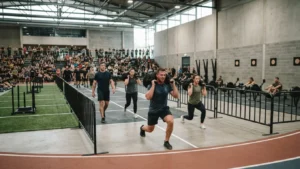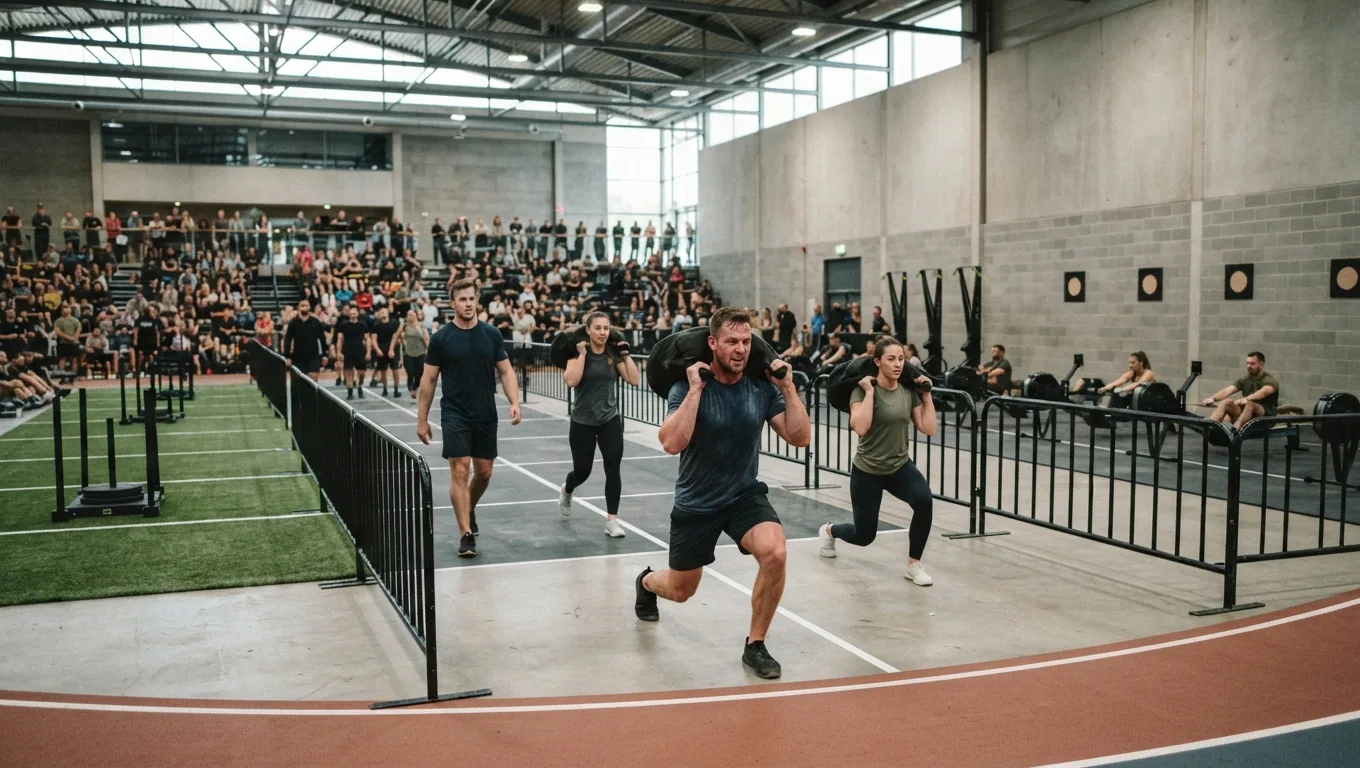
The hyrox sandbag lunges station is 100 metres long. On paper that is nothing — a walk to the end of the block and back. In practice it is where more races quietly fall apart than at any other station, and almost nobody trains for the specific reason it hurts.
The problem is not that the bag is heavy. It is that this is a judged movement, performed seventh out of eight, on legs that have already pushed a sled, pulled a sled, and jumped 80 metres of burpees.
1. The Rule That Decides This Station: Your Trailing Knee
Every other station in the race is measured. This one is judged, repetition by repetition.
The official singles rulebook is specific. During each lunge, the trailing knee must clearly touch the ground. Each repetition then ends with you standing tall, knees and hips fully extended. Lunges must alternate, and you are not permitted to take steps or shuffles between repetitions.
That last clause catches people out. A little half-step to reset your balance is not a tidy-up, it is a deviation.
The weights are set by division, and picking the right bag is your responsibility, not the judge’s:
| Division | Sandbag weight | Colour |
|---|---|---|
| Women | 10 kg (22 lb) | White |
| Women Pro / Men | 20 kg (44 lb) | Grey |
| Men Pro | 30 kg (66 lb) | Black |
Race any part of the station with the wrong bag and you repeat the whole 100 metres, or you are disqualified. If you want the full picture across every station, we have a definitive guide to the official Hyrox weights.

2. Why 100 Metres Feels Like 400: You Arrive Seventh
Here is the part that no amount of lunge practice on fresh legs will prepare you for.
The sandbag lunge is station seven of the eight that make up a Hyrox race. By the time you pick up that bag you have completed the ski erg, sled push, sled pull, burpee broad jumps, rowing and the farmers carry — plus seven kilometres of running. Your quads have been loaded eccentrically for forty minutes. Your grip has just been emptied by 200 metres of kettlebells.
Then you put a weight across your shoulders and ask your legs to control your bodyweight down and up, a hundred times, one leg at a time.
This is the same mechanism that makes your legs turn to jelly on the run, except here you cannot shorten your stride and jog it out. The movement standard does not bend to your fatigue.
3. The Mistake: Going Unbroken Because The First 20m Feel Fine
Watch any race and you will see the same thing. Athletes pick up the bag, set off at a rhythm that feels sustainable, and hold it for twenty or thirty metres. Then the reps get shallow, the knee stops touching, the judge starts counting infringements, and what was a rhythm becomes a grind with a warning attached.
The rulebook explicitly allows you to stop. You may lunge continuously or stop between each repetition with both feet parallel on the ground. Standing still with the bag on your shoulders costs you nothing.
So plan the breaks before you need them. Two deliberate five-second pauses — say at 40 and 70 metres — cost ten seconds. Two 15-second penalties for a knee that stopped touching cost thirty, and you will still be tired.
Break by distance, not by feel. Feel is the thing that has already lied to you twice by station seven.
4. Carrying the Bag Is a Skill Nobody Practises
The bag sits across your shoulders and behind your neck. It is soft, it shifts, and every repetition tries to roll it forward.
Three things matter. Set it high on the traps rather than low on the neck. Keep your hands actively pinning it rather than resting on it. And keep your torso vertical — the moment you lean forward to relieve your legs, the bag slides and you spend energy fighting it.
You also cannot solve this the way you would solve a grip problem elsewhere. Chalk is permitted only at the sled pull and the farmers carry. Using it anywhere else on the course, sandbag lunges included, is a two-minute penalty, and only event-provided chalk is allowed.
And the bag stays on you. The rulebook requires it to remain fully supported by the working athlete — never placed on the ground, barricades, your feet, or any other surface to remove the load. Each time you do, that is 15 seconds.
5. What Hyrox Sandbag Lunges Actually Cost When They Go Wrong
The penalty numbers look small individually. That is exactly why they are dangerous.
| Infringement | Cost |
|---|---|
| First deviation from the standard | Formal warning |
| Second deviation | 15 seconds |
| Knee not touching, or not standing tall | 15 seconds each |
| Removing the bag from your shoulders | 15 seconds each |
| Sandbag not returned to its marked area | 30 seconds |
| Racing with the wrong weight | Repeat the station, or disqualification |
Four sloppy repetitions in the last twenty metres is a minute. That is a bigger swing than most athletes gain from a season of ski erg work, and it is available to you for free, today, by touching your knee down properly.
One more detail that costs people time after the effort is over: the station ends when your leading foot crosses the finish line and you return the bag to the correct marked area. Athletes who dump the bag and jog off get 30 seconds unless they come back before leaving the Roxzone.
6. How to Train It Without a 100m Lane
Most gyms do not have a hundred metres of clear floor. That is fine, because the thing you are actually training is not distance.
Load the pattern, not the ego. Walking lunges with your race weight across the shoulders, 20 metres at a time, focusing on the knee touching every rep. Six to eight sets. If your knee stops touching, the set is over.
Train it pre-fatigued. This is the session that transfers. Do 200 metres of farmers carry at race weight, put it down, pick up the sandbag, and lunge 50 metres immediately. That transition is the actual race, and it feels nothing like lunging fresh.
Build the eccentric strength underneath it. Rear-foot elevated split squats and slow tempo lunges give your quads the capacity to control the descent when they are tired. Our guide to Hyrox strength training covers how to fit this around your running.
Count your own reps. Measure 20 metres, count your lunges, multiply by five. Now you know your number, and on race day you can count down instead of staring at a line that never gets closer.

Conclusion: The Cheapest Time on the Course
Hyrox sandbag lunges do not reward fitness the way the erg stations do. They reward knowing the standard, pacing by distance rather than feeling, and having practised the movement on legs that were already tired.
All three are trainable in a few weeks. That makes this the cheapest minute on the whole course — and given it sits immediately before 100 wall balls, arriving at the last station without a penalty and without wrecked quads changes how your race finishes.
Ready to fix the rest of your race?
- A Comprehensive HYROX Wall Balls Guide — the station that comes next
- Why Your Legs Turn to Jelly in Hyrox
- Master the Burpee Broad Jump
- The Ultimate Beginner’s Guide to HYROX
Frequently asked questions
How many lunges is 100m in Hyrox?
It depends entirely on your stride. A lunge step of roughly one metre puts you near 100 repetitions, but a shorter athlete taking 80 cm steps will do closer to 125. Count your own reps over a measured 20 metres in training and multiply by five, rather than trusting a number from someone else’s legs.
Can you put the sandbag down during Hyrox lunges?
No. The rulebook requires the sandbag to remain fully supported by the athlete at all times. It must not be placed on the ground, on barricades, on your feet, or on any other surface to take the load off, and each infringement carries a 15-second penalty. You may stop and stand still with the bag on your shoulders as long as you like.
What weight is the Hyrox sandbag?
Women use 10 kg (22 lb) marked white, Women Pro and Men use 20 kg (44 lb) marked grey, and Men Pro use 30 kg (66 lb) marked black. Selecting the correct bag is the athlete’s responsibility, and racing any part of the station with the wrong weight means repeating the whole thing or being disqualified.
What happens if your knee does not touch the ground?
Your first infringement is a formal warning. After that it is a 15-second penalty per infringement, listed in the rulebook penalty table as code 15, which also covers failing to stand tall at the top of a repetition.
Can you use chalk on the sandbag lunges?
No. Chalk is permitted only at the sled pull and the farmers carry. Using it anywhere else on the course, including the sandbag lunges, carries a two-minute penalty, and only event-provided chalk may be used.